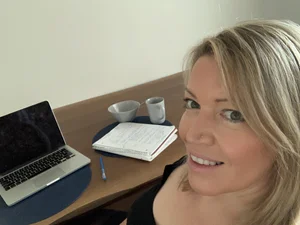
A beautiful AI designed representation of the modern enterprise sales person. Created 15 April 2026 by ChatGPT.
What we're getting wrong about top sales talent — and why AI can't fix a process that was already broken.
I was listening to The Challenger Sale on audiobook recently and it pulled a thread I've been tugging on for months. As someone who has been actively navigating the sales job market, I've had a front-row seat to a problem that most organisations are too polite — or too distracted — to name directly.
The hiring process for senior sales professionals is fundamentally broken. And AI isn't fixing it. If anything, it's making the cracks harder to see.
Let me tell you about my functional, emotional, and social jobs
If you've spent any time with Jobs-To-Be-Done theory, you'll know that what people say they want and what they actually need are rarely the same thing. So let me be honest about what I need from work — because I think it mirrors what a lot of experienced sales professionals actually need, even if nobody puts it this plainly in an interview.
My functional job is to make money. Full stop. I started life on my own very early and learned fast that earning was a path to safety and, eventually, to actually enjoying life. A friend I've worked for can attest that during annual leave I sometimes picked up paid work for him. I also studied full-time while working full-time. Hard work isn't a personality quirk for me — it's just the baseline.
My emotional job is to be successful and proud of myself, while remaining genuinely available for my son, who has had far too many difficult moments for his age. Secondary to that: to be treated with respect, to have real agency, and to feel confident I have the support I need to go beyond goals — not just meet them.
My social job? To be accepted and understood. I've spent most of my career being described as a maverick, someone who walks to their own beat, someone with moxie. I don't try to fit in. I try to do excellent work.
I tell you all of this because those aren't unusual jobs. Most ambitious sales professionals carry some version of this list. And yet — the hiring process almost never accounts for any of it.
The job that brought out all my emotions
A few years ago I started a role I was genuinely excited about. And I mean properly excited — the kind that feels almost embarrassing to admit. My friend Megan Jensen can confirm this is a story that still pulls on something in me when I tell it.
The training actually cared about making sure you knew the company you were representing. It cared about whether you could customise your pitch, whether you knew where to find what you needed to succeed. I met Patrick Schweirking — a bit intimidating, honestly — but he took the time to talk to me and give me a real perspective on where to focus to get quick wins. I met people who were polished and professional and seemed genuinely invested in the outcome.
This was what I had been working toward. Having navigated Fortune 500s with solid systems, where the commute or the TFL crush at rush hour (weeks after giving birth — that's a whole other book) were the hardest parts of my day — I knew what good felt like. And this felt like good.
And then I got an email I had been waiting years for. The UK government was reinstating my residency. They gave me a 90-day window to return… or lose it forever.
Elated and gutted, simultaneously.
I must've made a good impression, because the same company employed me in the UK. The team I joined here was extraordinary — I genuinely felt like we could do something remarkable together. And then senior leadership decided to close the UK office. (Moving from public trading to PE with a new foreign office on the books that would take time to turn profit wasn’t a good balance sheet item).
The great people. Gone.
The complex, interesting deals. Gone.
The mentorship, the structure, the sense of possibility. Gone.
But I was home. And I don't regret the move for a second.
The head fake nobody talks about
I was standing on my doorstep in the California sun, talking to the wife of a friend of a friend — let's call him Charlie — who is, by any objective measure, a phenomenal sales person. The kind who has made a genuine fortune. She was explaining how hard he had found it to move from a role with warm leads, existing accounts, and referrals into a new position that promised "end-to-end pipeline management."
Fine in the interview. Sounded reasonable. Modern, even.
In reality? End-to-end meant: you're on your own. This highly experienced, talented professional was sitting at his desk grinding through LinkedIn messages, calling contacts to follow him to a new employer, writing his own collateral, running his own webinars, and doing it all without meaningful support. Leads from inside sales counted for less. Partner referrals counted for less. His success was defined entirely by his ability to independently identify, approach, and close complex prospects from scratch.
I laughed — the kind of laugh that's really relief. If Charlie struggles with this, I feel a bit more human.
But it isn't funny. Not even slightly.
What I heard at Boye + Co — and what it made me think
Not long ago I was at a Boye + Co event where experienced leaders were talking about AI's impact on employment. They talked about job descriptions that are already 1.5 to 2.5 FTE in scope. About teams resisting the change AI brings. About real anxiety around what roles will look like in two years.
And I thought about a company I'd spoken to recently — a billion-dollar consultancy, newly created role, open to salary expectations. Promising. But the JD they sent was as vanilla a sales role description as I've ever read. So I asked a simple question: would there be marketing or inside sales support, or would this be fully just me managing end-to-end?
Crickets.
I'm a sales professional. I followed up.
Crickets.
Which tells me something. Either they don't know the answer yet, which means the role isn't actually ready to be filled. Or they know the answer and they know it's the wrong one.
The question you actually need to be asking
Here's what I'd love hiring managers and sales leaders to sit with:
What are the most valuable things your top 10% of sales professionals actually do?
Do they genuinely drive every stage of the process? Or are they exceptional at the complex, human, judgment-intensive parts — the qualification, the trust-building, the navigation of a multi-stakeholder sale — and only doing the rest because nobody else is?
Because if you want real growth, the problem to solve isn't finding a unicorn who can do everything. It's generating enough qualified interest that your best people are consistently focused on the work only they can do. Everything else is a loss of efficacy.
And yes — this is exactly where AI can help. The repetitive, low-signal, top-of-funnel tasks are genuinely amenable to AI-powered support. Outreach at scale. Content generation. Lead scoring. Research. But here's the thing: AI still needs to be overseen by a human who understands what good looks like. And right now, many organisations are asking their most expensive humans to do both the AI-replaceable work and the irreplaceable work, and then being surprised when neither gets done well.
A 30/60/90 for hiring managers
We talk endlessly about 30/60/90 day plans for new hires. We almost never talk about a 30/60/90 review of the hiring manager — a structured reflection on whether the role as described actually matched the role as lived, and whether the support promised materialised.
I think that's the conversation worth having. Not just for candidates. For organisations that want to stop losing great people to the gap between what was sold in the interview and what turned up on day thirty, sixty, and ninety.
I see this problem a lot. It's one I care about deeply — and it's exactly the kind of thing I work through with sales leaders at Moxie89. If it resonates, I'd love to hear how it shows up in your world. Drop a message if you want to discuss more.